

Mind Age® Clock: Enhance Mental Health and Build Resilience
Psychological Health
Wellbeing Insights
AI Precision
Future Ready
The Mind Age Clock measures your psychological wellbeing and resilience, predicting how your mind is aging compared to your chronological age. By analyzing stress, mood, and cognitive patterns, it empowers individuals, clinicians, and organizations with insights that improve mental health, prevent burnout, and support long-term wellbeing.
Revolutionizing Health with Mind Age
What is Mind Age®?
The Mind Age® Clock offers insights into the cognitive and emotional aspects of aging. By assessing an individual’s perception of time, which can significantly impact behaviour, emotions, and overall well-being, the Mind Age® Clock provides a unique measure of mental age. This subjective experience varies by person and is influenced by factors such as age, cultural background, personality, and life experiences.
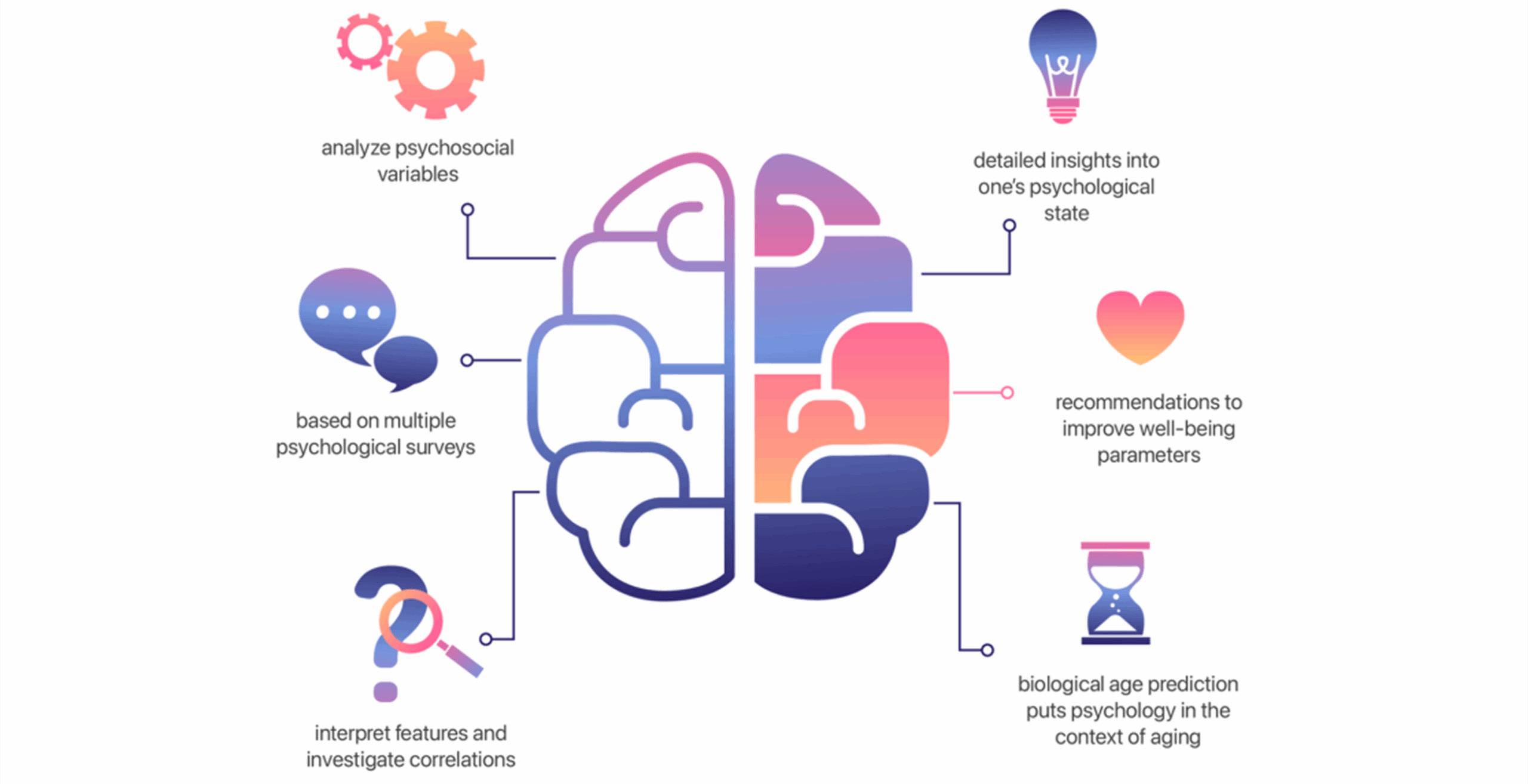
Combining self-assessment surveys with cognitive testing, our Mind Age® Clock delivers a detailed report on mental health and overall well-being. The report deep dives into various personality traits captured through 6 wellbeing scores and provides recommendations to improve upon these parameters. Use these insights to make informed lifestyle and healthcare decisions aimed at enhancing mental health and improving well-being as you age.
How Mind Age® works?
- Psychological Survey filled by the user
- Mind Age compared to chronological age
- Interventions from Psychologists and other Experts
- Tailored content, Tips, Adherence Reminders
- Repeat the survey and continue to be on the wellness path
Answering the Questionnaire
By completing our expertly designed survey, our AI algorithm can evaluate your current mental health and determine your overall well-being. This assessment provides valuable insights into your cognitive and emotional well-being, helping you understand and manage your mental health more effectively.
Mind Age® Report on core Wellbeing Parameters
The Mind Age Report evaluates core wellbeing parameters, offering deep insights into cognitive resilience, emotional balance, and mental performance to support healthier aging and long-term brain vitality.

Who is it for?
Hospitals
Help patients improve their psychological wellbeing and mental resilience. Expand services, improve customer retention and get more revenue.
Employers
HR Leadership can now really take care of the employees. Improve the enthusiasm and productivity of the workforce. Mind Age technology can help cultivate a more resilient work culture, keep employees happy, improve productivity and increase talent retention.
Insurance
Novel customer engagement – offer personalised recommendations for improved mental health and wellbeing based on the psychological profile of a person. Attract more leads and keep customers engaged with a cutting-edge mental health technology.
Mental Health
Mental Health with an A(I) Difference
Empower patients to evaluate their psychological well-being, understand the consequences, and seek timely help. With AI-driven insights, factors like high glucose levels, as well as balanced chloride and potassium, can be tracked to reveal their impact on biological age and overall health—helping patients stay informed, motivated, and committed to better mental and physical wellness.
Personalization
We recognize that each individual is unique, and there is no one-size-fits-all approach to mental health. For instance, workplace anxiety may manifest differently for different people. Psychologist-recommended interventions, such as time management training, mindfulness practices, and cognitive-behavioural therapy, help individuals manage their perception of time and enhance overall well-being.
AI-driven mental wellness cycle
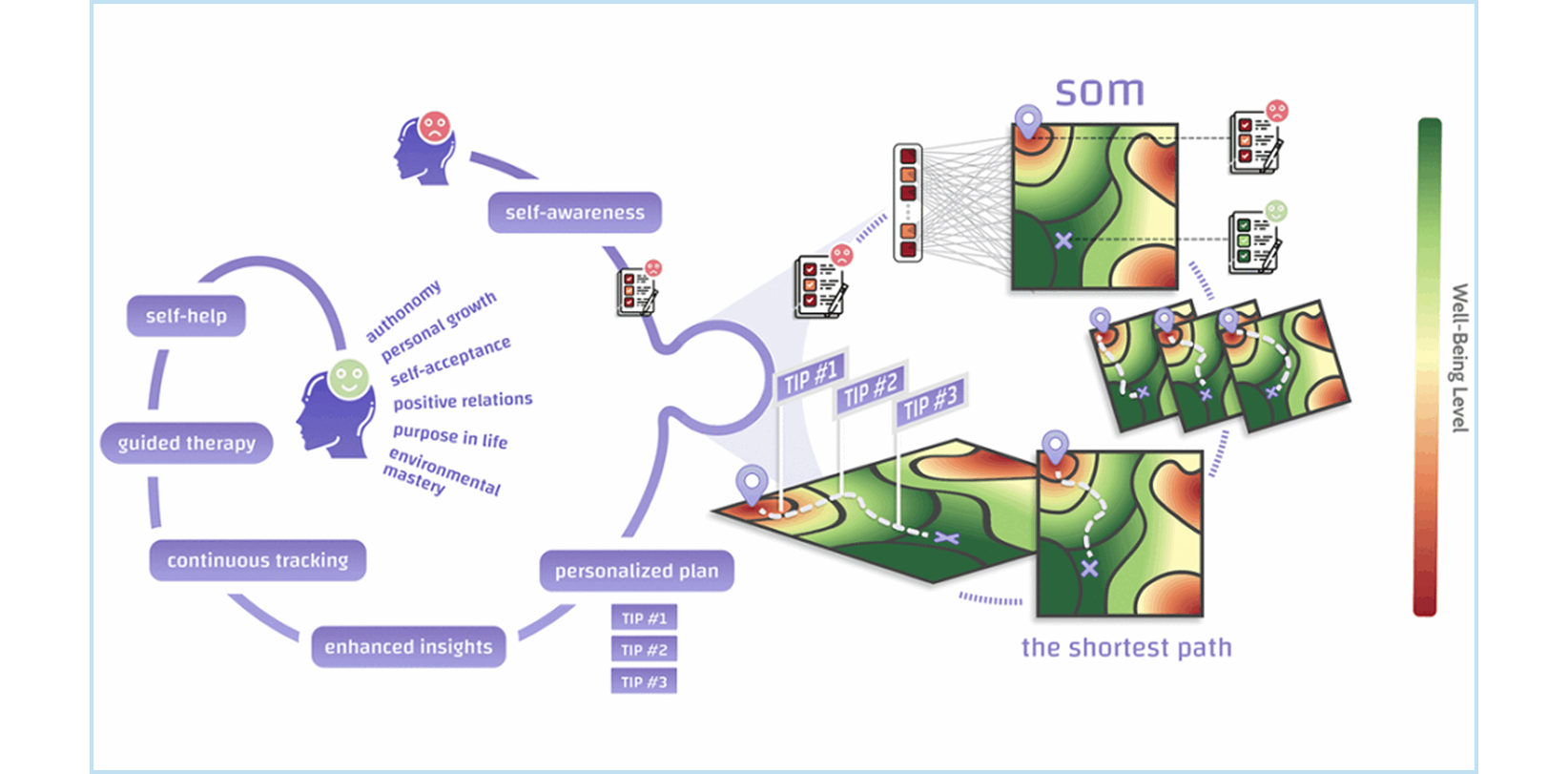
Ensemble of deep learning models analyses user-submitted questionnaire to provide personalised recommendations that are aimed to increase one’s mental health, resilience and longevity potential. Personalisation improves the acceptability and engagement of the intervention by making it relevant and meaningful to the individual. This can be important, as these interventions may require a significant commitment of time and effort from the individual.
Mind Age and Happiness
CEO of Deep Longevity, Deepankar Nayak, speaks at King’s College London
Know more about Mind Age
What is Mind Age?
Mind Age is Deep Longevity’s aging clock that estimates one’s psychological or Lifestyle age based on a psychological / lifestyle questionnaire. A respondent’s answers may be collected online, in person, via a phone interview / contact centre, or printed forms. In addition to a psychological age estimate, respondents will receive useful tips on how to improve their psychological well-being and a complete report on mental health.
What is psychological age?
Human motivations and emotions evolve as people grow older. Some of these psychological trends are so reliable that they may be used to guess one’s current chronological age. Psychological age is thus one’s position in this array of psychological transformations expressed as years of age.
Due to a variety of personal histories and innate tendencies some people go through their aging-related psychological progression faster than others. Unlike biological age, it is not always better to have lower psychological age. One’s life goals and priorities determine if their current psychological age is suboptimal: some people would benefit from adopting a more mature outlook while others might need to become younger at heart.
How is psychological age connected to biological age and health?
Good mental health is an essential part of healthy aging healthy aging. Our research has shown that poor psychological health acelerates one’s biological pace of aging. Some people might actually improve their mental and physical health by adopting a more mature mindset.
How is the Mind Age clock validated?
Mind Age, as well as other aging clocks developed by Deep Longevity, have been published in peer-reviewed academic journals .
Is Mind Age ready and available for clinical and medical uses?
Mind Age is not a diagnostic tool. However, it may be able to assist healthcare professionals for the purposes of initial assessment of psychological state and further progress by monitoring the response of patients to our psychological questionnaire in guided therapies . Some itFuturSelfrations of Mind Age, such as FuturSelf, may also be used as a self-improvement tool without professional oversight.
Our recommendation engine provides personalized tips self-improvement based on an individual’s current mental state assessed with Mind Age.
How does Mind Age use machine learning to calculate psychological age?
Our Mind Age project is an ensemble of deep learning models trained to predict one’s chronological age, mental health risks, and future well-being.
By processing thousands of psychological profiles obtained from public sources such as MIDUS and NHANES with deep learning algorithms, we have created these tools that may be used to gain useful insights on users’ mental health. Making these models available through projects like futurself.ai has allowed us to collect tens of thousands of psychological profiles that we have used to fine-tune Mind Age models.
Currently, the Mind Age project consists of deep neural networks, self-organizing maps, and clustering algorithms that exchange their outputs to parse aging-related trends in human psychology and determine the best course of action for each users based on their background.
How does the Mind Age recommendation engine work?
Self-organizing maps are the foundation of our Mind Age recommendation engine. It is a method of unsupervised learning that groups people on a 2D plane based on the similarity of their psychological profiles. The regions on this map are scored based on the associated risk of mental illness, personal preference, and level of mental well-being. Then, the adjacent high scoring region is picked as the destination point for a user. Once the itinerary for a new user is composed, a curated database of psychological advice is sought for entries that can promote the desired shift in the psychological profile.
Can these recommendations be followed without professional oversight?
Mind Age offers the tools that may be used for self-improvement with no professional guidance. However, we believe that AI-tools cannot replace the nuanced attention a human expert can provide to their patient through one-on-one sessions.
How long does it take to get reports?
Mind Age Summary reports can be generated within minutes after completing the survey. Our team is always there if you run into any problems.
How will patient data be used?
Deep Longevity may use anonymized patient data for further research and fine-tuning of its deep learning models.
Are there any data privacy concerns? Where is Mind Age patient data stored?
We use best-in-class security practices and encryption to secure patient data. All the information-handing is compliant with international and local laws.
The Mind Age aging clock, as well as all the patient data, is stored on Amazon AWS servers.
How to sign up for Mind Age as a Hospital, Lab, or Business?
As of December 2022, Mind Age can be accessed by our commercial partners. Mind Age is currently being integrated into our B2B portal SenoClock.AI and is expected to be released as an extension to it in Feb 2023.
For further inquiries on the commercial availability of Mind Age, reach out to us at support@deeplongevity.com
Do you provide a trial account for hospitals? How to sign up for the Mind Age free trial?
Yes. We can provide a trial account for hospitals and other businesses that may want to implement Mind Age for their patients, customers, or employees.
Please write to us at support@deeplongevity.com. Our team will connect you with an expert as soon as possible.
Is it possible to integrate Mind Age with our patient management software and other programs?
Yes. Mind Age can be accessed via API to enable the development of third-party tools and plug-ins for existing software.
How many reports can Mind Age generate in a day?
Mind Age’s throughput is practically uncapped as it is hosted on the cloud.
If you operate at a large scale, please contact us for a special arrangement.