

Blood Age – your blood has a story to tell
54 Biomarkers
Early Detection
Personalized Insights
API Ready
Our Blood Age clock is a revolutionary tool for understanding and tracking the aging process at the cellular level. Using a simple blood test, our clock accurately measures the biological age and provides a comprehensive report on the health of your blood and overall aging status. Blood Age clock looks at the internal state of your body to give a more accurate representation of your true age. This information can be used to make lifestyle and healthcare decisions that can help you age healthier and live longer.
With our Blood Age clock, you can:
Understand your current aging status and identify potential health risks
Track changes in your Blood Age over time and monitor the effectiveness of interventions
Make informed decisions about your health and wellness based on data-driven insights
- Receive personalized nutritional recommendations to address nutrient deficiencies, improve organ health, and support overall well-being
Revolutionizing Health with Blood Age
Get more from your clinical blood report
The standard clinical blood report indicates which measures are out of range. Blood Age clock can use the same report to make very accurate predictions on the biological age, understand which blood markers are affecting the aging process the most as well as the risk of mortality assuming current health conditions and make AI driven recommendations to improve health.
Securely Exchange Information
Blood Reports can be shared in an anonymized format if necessary.
Blood Reports are accessible via secure APIs as well as Deep Longevity’s SenoClock SaaS portal. Our SenoClock SaaS platform will allow our customers to access our application over the web while the application will be hosted in the region.
Our Servers are hosted globally following local data protection policies.
Easy to use and most popular of biological clocks
Low cost – blood reports are the least expensive of biological tests
Short Turn Around Time (TAT in days) for blood reports
Labs in every clinic, every city around the world
Decades of research on blood parameters provides rich library of recommendations personalised by the algorithms
Most popular and universally available
Blood reports can be in any format, from any region, country or lab and in PDF, CSV or Excel file

List of biomarkers
A comprehensive collection of biomarkers reflecting vital health indicators, supporting diagnosis, monitoring, and personalized treatment strategies to promote longevity, wellness, and disease prevention.

Blood Summary Report
Blood Age Prediction
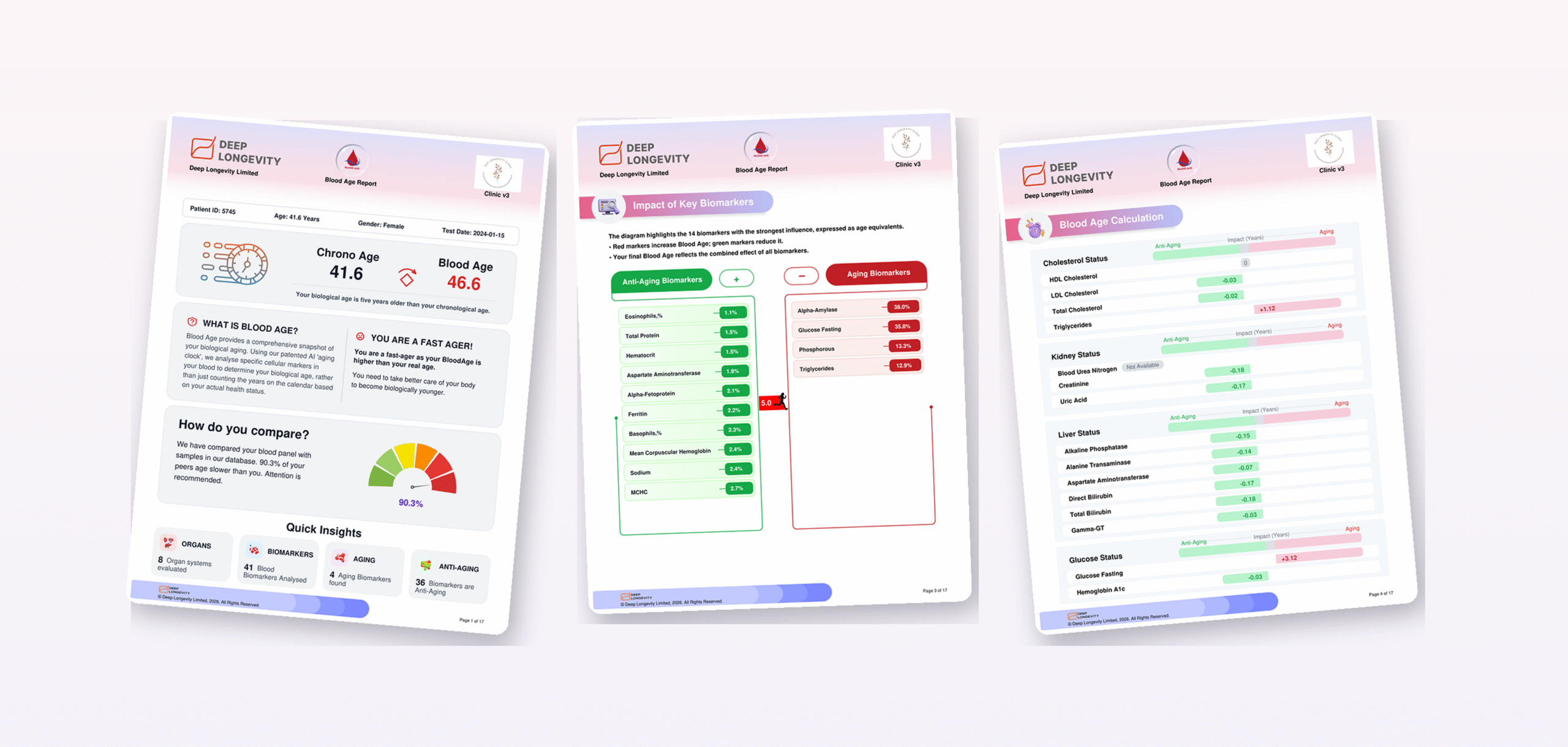
The Blood Age Report provides insights into your biological age based on blood biomarkers, comparing it to your chronological age. A lower blood age signifies a healthier biological state, while a higher one may indicate potential health risks. This report also includes a peer comparison, showing how you rank among others in your demographic. With actionable recommendations, the Blood Age Report empowers you to take steps toward healthier aging and potentially reduce your biological age, helping you optimize wellness and longevity. Start understanding your health at a cellular level and take control of your aging journey.
Biomarker Impact Analysis
The Biomarker Impact Analysis highlights the effects of key blood biomarkers on your biological age. Biomarkers are categorized as age-accelerating or age-reducing based on their impact. For instance, high levels of glucose may accelerate aging, while balanced levels of chloride and potassium may reduce biological age. This analysis empowers you with personalized insights, guiding you on which biomarkers to focus on for slowing down biological aging. By understanding these markers, you can make informed health decisions to achieve a younger biological age and improve overall longevity.
Comprehensive Biomarker Analysis
Our report incorporates a comprehensive analysis of 54 biomarkers, providing a more holistic view of your health. Of these 54 biomarkers, 45 are used to calculate your biological age, offering insights into how well your body is aging at a cellular level. Additionally, 9 carefully selected biomarkers focus on specific organ health scores, helping you understand the functional status of vital organs such as the heart, liver, kidney, etc.
Blood Age Analysis
Personalized Health Recommendations
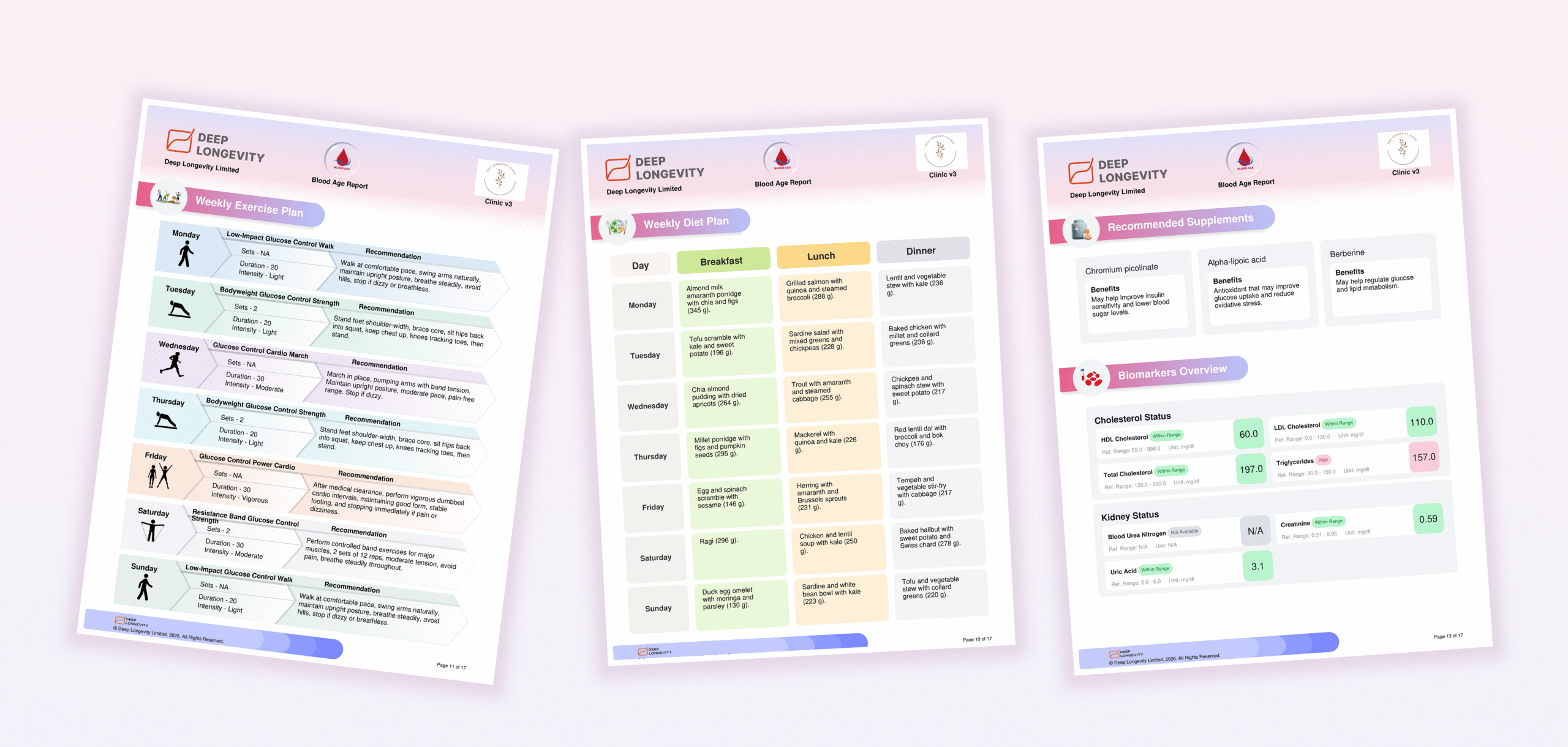
The Report provides highly personalized recommendations tailored to your specific health profile and individual goals. It offers weekly diet plans, customized exercise routines, targeted lifestyle adjustments, and supplements aimed at correcting deficiencies and enhancing both biological and organ health. The recommendations are designed to be comprehensive and adaptive, ensuring they align with your evolving health needs.
Expanded Organ Health Scores
To have better insight, the organ health scores offer an enhanced assessment with detailed scores for eight key organ systems: Immune, Bone, Inflammation, Glucidic, Cardiovascular, Mineral, Kidney, and Liver health. This detailed evaluation provides users with deeper insights into the condition of their vital organs, improving decision-making.
Weekly Nutritional Summary
A comprehensive overview of your nutrient intake on a weekly basis, ensuring that your diet covers all the essential vitamins, minerals, and macronutrients needed to support optimal health and longevity. In addition to optimizing your nutritional balance, this summary is designed to improve organ health scores by addressing nutrient deficiencies that may impact the function of vital organs.
Understand your Organ Health, beyond your Blood Age
See the health of your vital systems
Organ Health Scores provides deeper analysis of your health by examining relevant blood biomarkers, the report provides individual health scores across key physiological systems, helping you understand where your body may be performing well and where it may need greater attention.
Turn blood biomarkers into meaningful health insights
Organ Health Scores looks at a combination of blood biomarkers to provide a clearer picture of your cardiovascular, liver, kidney, immune, bone, inflammation, glucidic, and mineral health. This helps transform complex laboratory data into insights that are easier to understand, track, and act upon.
Identify areas to focus on for healthier aging
Understanding your organ health can help you take a more targeted approach to healthy aging. Your scores can highlight areas that may benefit from closer monitoring, healthier lifestyle choices, or personalized recommendations. By tracking these insights alongside your Blood Age, over time, you can better understand how changes in your health may influence your biological aging and support more informed conversations with your healthcare professional.

Blood Age Report Explained
Watch our demo video for a comprehensive tour of this powerful AI-driven platform. Gain unprecedented insights into your overall potential for well-being with highly personalized, innovative, and actionable recommendations to enhance longevity and achieve your wellness goals.
Know more about Blood Age
What is Blood Age?
Blood Age is Deep Longevity’s aging clock that measures biological age based on panel of standard blood tests. In addition to biological age calculation, the clock also reveals its main contributors and recommends solutions to reduce the aging rate.
How is Blood Age generated or created?
Blood Age uses regular clinical blood reports to predict biological age. Blood reports can be from any lab, any country or region, any language and format. Deep Longevity algorithms can handle all that complexity and using those inputs generate a blood summary report that predicts biological age, outlines which blood biomarkers are aging and anti-aging and gives recommendations to improve longevity and health.
What is biological age?
Aging is the process of damage accumulation spread across decades. Due to cross-individual differences in genetics, lifestyle, and medical history, each person accrues aging-related damage at a different rate. While chronological age determined by one’s date of birth is a useful proxy for the amount of this type of damage, it fails to capture the variability in the true, biological aging rate.
Biological age may be understood as a golden standard of the aging process developed by measuring its molecular footprints. Expressed in the same units as chronological age, years, it offers a more personalized approach to longevity. While one cannot reverse time to decrease their chronological age, it is absolutely possible to reduce the biological age and become a younger version of oneself.
How is biological age connected to aging and health?
Featured in a number of peer-reviewed academic studies on aging, Blood Age has been proven to be a better predictor of mortality than chronological age in Asian, European, and North American populations. The increased pace of aging has been shown to be associated with a variety of health conditions and mortality.
You may read more about Blood Age research in our Science Section.
Is it available for clinical use?
Blood Age is not a certified diagnostic tool and was developed to assist healthcare professionals provide personalized care and advice to their patients. Physicians may employ Blood Age to provide patients with a unique longevity-focused perspective on their health situation and differentiate their practice in the marketplace.
We believe that professional expertise is the best approach to medicine, so we advise using Blood Age-generated reports in supervised settings only.
How can AI diagnose and calculate biological age?
Humans, by intuition, can guess age based on appearance because it changes as we grow old. People who look older at a young age are considered not well while those who look younger at an old age are admired.
Blood Age expands on the same idea. But it looks deeper than appearance. We check blood test data to calculate the current biological age of a person, a task no human has intuition for.
We have developed digital models that study blood test data in the context of age. These models are trained using hundreds of thousands of historical patient data entries until they have developed the intuition to interpret the biomarkers in the context of aging.
What other information can Blood Age provide?
Along with biological age, Blood Age also reveals the main factors contributing to one’s aging rate and possible solutions or treatments to decrease it.
Professional supervision is advised in conjunction with the automatically generated recommendations.
How does the recommendation engine work?
Blood Age creates numerous digital lookalikes of the original submitted blood panel with slight variation and searches for a configuration of blood biomarkers that yield the greatest improvement in terms of biological age. The exact method we are using is called “particle swarm optimisation”. In the end, Blood Age checks a curated database of evidence-based interventions that can result in the desired blood biomarker configuration.
How many years can you gain if you follow Blood Age recommendations?
The efficiency of the recommendations applied greatly depends on how healthy your lifestyle was before trying Blood Age. Generally speaking, people with an increased pace of aging can expect the greatest benefits by following the recommendations provided by our system. If you have previously delved into biohacking territory, your biological age gains might not be as significant since you might already be following the recommendations in our database. Instead, your focus should be on monitoring the pace of aging and trying to align it with the recent changes in lifestyle.
To be more specific, our recommendations can help a fast ager become a slow ager by erasing years of biological age and allow a slow-ager to maintain that pace and even improve it.
Does Blood Age recommend dietary supplements?
Yes. Blood Age recommendation database has some possible dietary supplement solutions.
Expert supervision is strongly advised before you start a new supplement course.
How will Deep Longevity use patient data in the future?
Deep Longevity may use patient data for further studies and research projects. It helps us develop better tools to improve human health and longevity.
Are there any data privacy risks? Where are Blood Age's and Deep Longevity’s servers located?
We use state-of-the-art cybersecurity technology and encryption to secure all patient data. The platform deletes all data after 72 hours unless needed by the customer. Further, the information is protected by international and local laws.
How to sign up for Blood Age free trial as hospitals and businesses?
Visit Deep Longevity’s aging clock platform: SenoClock.
How long does it take to get the Blood Age reports?
Blood Age Summary reports can be generated within a few minutes. Please check your internet connection and reach out to our support team if you run into any problems.
How long does it take to learn Blood Age?
We offer training seminars to hospital staff on how to use Blood Age in their practice. The user interface is quite intuitive a. And the training doesn’t take more than one hour. For more information, watch our YouTube live demos.
How many Blood Age reports can be generated in a day?
There is no limit on the number of reports. You can generate as many reports as you need in one day.
Is it possible to integrate Blood Age with our hospital management software and other platforms?
Yes. Our API can be used to integrate Deep Longevity with any program. Contact support@deeplongevity.com to request a technical meeting so we can help you set up programmatic access to Blood Age or any other aging clocks.
Do you provide an API?
Yes. The aging clock platform, SenoClock, comes with a robust API. It has more features compared to the GUI version and is the best solution for companies who wish to build their own longevity medicine platform.
What are the key differences between Version 1.0 and Version 2.0?
Version 1.0 of the Blood Age Report offers a comprehensive analysis of 45 essential biomarkers and organ health scores for four vital organs. In contrast, Version 2.0 includes an additional 10 biomarkers, expanded organ health scores for eight key organs, and personalized health plans with weekly diet, exercise, supplement, and lifestyle recommendations. This upgrade provides users with more detailed insights and tailored guidance for optimizing their health and well-being.
Are there any differences in the types of organ health scores provided between Version 1.0 and Version 2.0?
Yes, there are differences in the types of organ health scores provided between Version 1.0 and Version 2.0 of the Blood Age Report.
In Version 1.0, the organ health scores focus on four vital organs: kidney, liver, glucose, and lipid health. These scores are derived from a comprehensive analysis of relevant biomarkers associated with these organs.
However, in Version 2.0, the organ health scores have been expanded to include detailed assessments for eight key organs: immune, bone, inflammation, glucidic, cardiovascular, mineral, kidney, and liver health. This expanded evaluation offers users deeper insights into the functionality and condition of their vital organs, enhancing their ability to make informed decisions about their health and well-being.
How does the inclusion of additional biomarkers and expanded organ health scores in Version 2.0 contribute to a more comprehensive understanding of overall health compared to Version 1.0?
The inclusion of additional biomarkers in Version 2.0, such as C-reactive protein (CRP) and Vitamin D, along with expanded organ health scores for eight key organs, provides a more holistic assessment of health compared to Version 1.0. This comprehensive analysis offers deeper insights into various physiological processes and organ functions, enabling users to gain a more nuanced understanding of their overall health status and potential areas for improvement.
How can we upgrade from Version 1 to Version 2?
If you’re currently using Version 1 and wish to upgrade to Version 2, please reach out to us at: support@deeplongevity.com.
What will happen if fewer biomarkers are provided in the report, will the report be processed and with what changes?
If the report includes fewer biomarkers, the report will still be generated successfully. However, the accuracy of the organ health scores may vary depending on the number of biomarkers provided.